
.
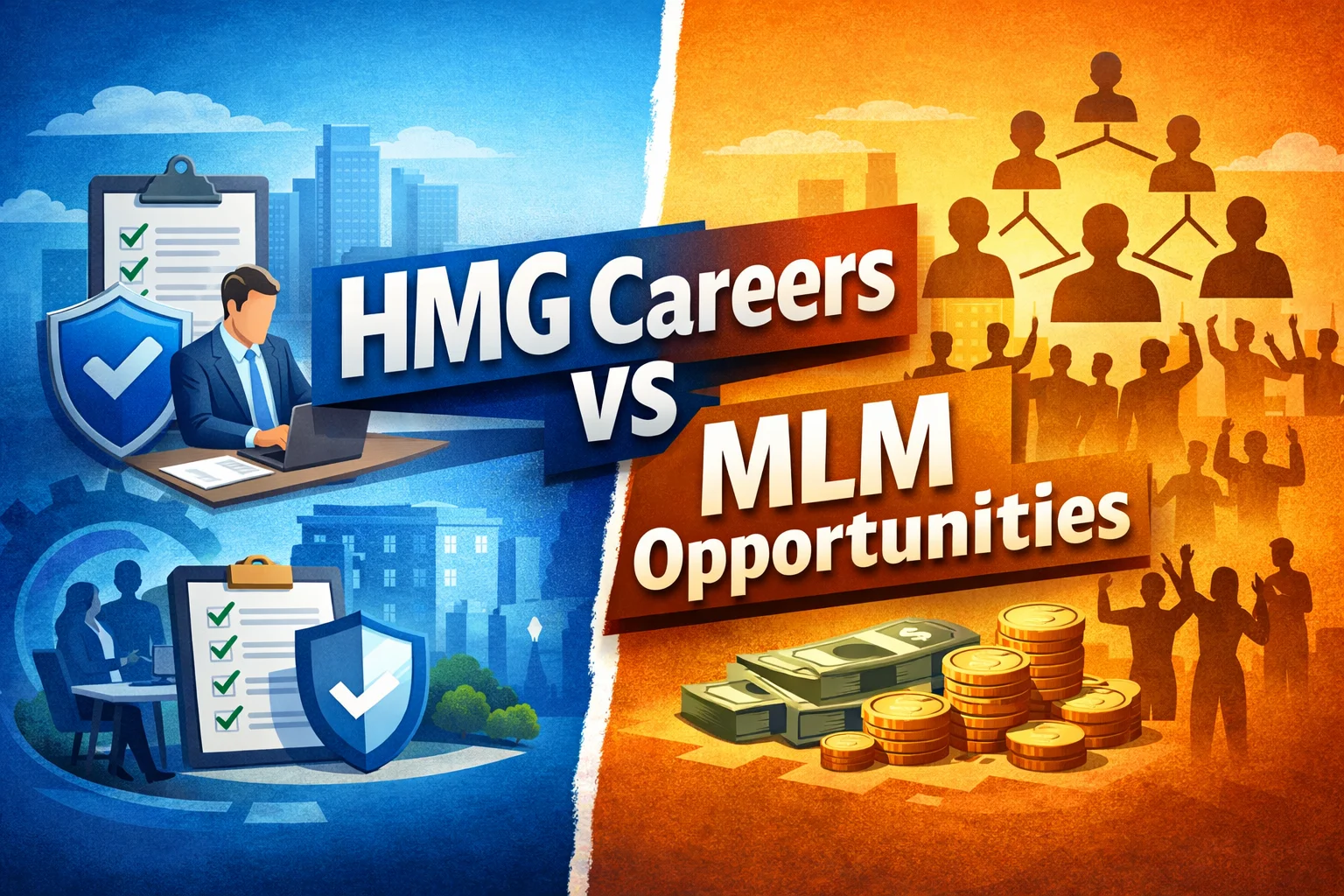
If you’re exploring remote income opportunities, you’ve likely come across both HMG Careers and multi-level marketing (MLM) models. At first glance, they can seem similar, as both offer flexible work, independent structures, and performance-based growth.
However, there are clear differences between the two, and understanding those distinctions is essential—especially if you are new to the insurance industry.
This guide breaks everything down in simple terms, covering licensing, training, required skills, and expectations to help you make an informed decision with confidence.
Understanding MLM Opportunities
Multi-level marketing (MLM) is a business model where individuals earn income through:
- Direct product sales
- Recruiting others into the network
- Commissions based on team performance
According to the Federal Trade Commission, MLM structures can vary widely, but legitimate models typically focus on product sales rather than recruitment alone.
That said, MLM opportunities are often associated with:
- A heavy emphasis on building a downline
- Inventory purchases (in some cases)
- Variable income tied to network size
This structure works for some individuals, but it differs significantly from professional, licensed industries such as insurance.
What Are HMG Careers?
HMG Careers connects individuals with opportunities in the insurance sector through a structured, remote-first model.
Unlike MLM systems, insurance-based roles are tied to:
- Licensing requirements
- Regulatory compliance
- Client service standards
This professional foundation is what separates insurance pathways from traditional MLM structures.
Key Differences: HMG Careers vs MLM Opportunities
| Feature | HMG Careers (Insurance Model) | MLM Opportunities |
|---|---|---|
| Industry Type | Insurance (regulated industry) | Direct selling / network marketing |
| Licensing Requirement | Often required (exam + compliance) | Typically not required |
| Income Source | Client services and policy-related work | Product sales and recruitment commissions |
| Regulation | Governed by industry regulations | Varies by company |
| Training Focus | Compliance, professional development, client service | Sales tactics and recruitment strategies |
| Career Path | Structured, performance-based growth | Growth tied to network expansion |
| Long-Term Stability | Built on industry demand and skills | Dependent on sustaining a network |
Feature
Industry Type
- HMG Careers (Insurance Model)
- Insurance (regulated industry)
- MLM Opportunities
- Direct selling / network marketing
Feature
Licensing Requirement
- HMG Careers (Insurance Model)
- Often required (exam + compliance)
- MLM Opportunities
- Typically not required
Feature
Income Source
- HMG Careers (Insurance Model)
- Client services and policy-related work
- MLM Opportunities
- Product sales and recruitment commissions
Feature
Regulation
- HMG Careers (Insurance Model)
- Governed by industry regulations
- MLM Opportunities
- Varies by company
Feature
Training Focus
- HMG Careers (Insurance Model)
- Compliance, professional development, client service
- MLM Opportunities
- Sales tactics and recruitment strategies
Feature
Career Path
- HMG Careers (Insurance Model)
- Structured, performance-based growth
- MLM Opportunities
- Growth tied to network expansion
Feature
Long-Term Stability
- HMG Careers (Insurance Model)
- Built on industry demand and skills
- MLM Opportunities
- Dependent on sustaining a network
Why This Distinction Matters for Beginners
For beginners, choosing between a regulated industry like insurance and a network-based model like MLM can shape long-term career outcomes.
Licensed pathways introduce professional standards early on. While training, compliance, and licensing may seem like extra steps, they build a foundation based on accountability, expertise, and transferable skills.
MLM models often prioritise fast entry and rapid network expansion. While appealing to some, they may not offer the same level of structured skill development or long-term clarity.
Understanding these differences allows you to move forward with intention rather than uncertainty.
How to Get Started in the Insurance Industry (Beginner Roadmap)
Step 1: Learn the Basics
Start by understanding insurance fundamentals such as risk protection, policy structures, and client advisory roles. No prior experience is required—only a willingness to learn.
Step 2: Apply Through Official Channels
Submit your application through official company platforms to ensure accurate information and verified onboarding steps.
Step 3: Virtual Screening & Interviews
Candidates are typically interviewed via Zoom, where expectations, compensation structures, and training requirements are explained.
Step 4: Complete Training
Structured training prepares individuals for real-world scenarios and compliance responsibilities.
Step 5: Obtain Licensing (If Required)
Licensing ensures professionals meet industry standards and operate responsibly.
Step 6: Develop Core Skills
Key skills include communication, problem-solving, consistency, discipline, and comfort with remote tools.
Step 7: Begin Working with Clients
Once onboarded, professionals begin client engagement with ongoing mentorship and system support.
Final Thoughts
Choosing between HMG Careers and MLM opportunities ultimately depends on your goals, work style, and long-term vision.
For those seeking a regulated industry, professional skill development, and a structured remote environment, the insurance pathway offers clarity and scalability.
Frequently Asked Questions (FAQs)
1. Is HMG Careers suitable for someone transitioning from a different industry?
Yes. Individuals from retail, customer service, education, and administrative backgrounds often transition successfully due to transferable skills.
2. What level of commitment is expected?
Remote roles still require professional commitment, including training participation, performance expectations, and consistent communication.
3. How long does it take to get started?
Timelines vary based on onboarding and licensing requirements.
4. Can this be done alongside another job?
Some individuals explore these roles part-time initially, though long-term success depends on focus and consistency.
5. How is performance measured remotely?
Performance is tracked through digital systems using metrics such as activity, consistency, and outcomes.