
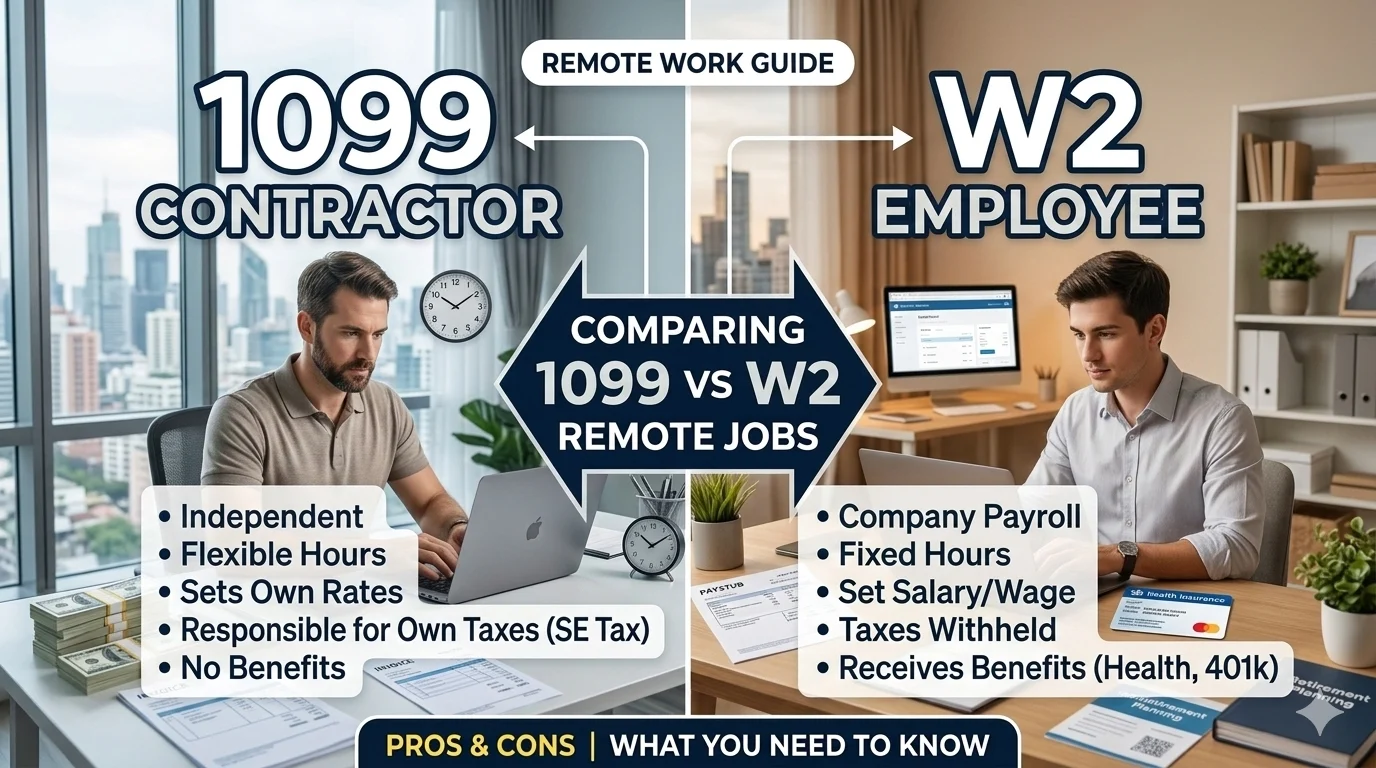
1099 vs W2 remote jobs is one of the most important things to understand when looking for work you can do from anywhere. Knowing the difference helps you choose a role that fits your lifestyle, income goals, and work preferences.
In this guide, we explain both types of remote jobs in simple terms and show how to decide which one works best for you.
What 1099 and W2 Mean for Remote Work
Let’s start by understanding what each type of remote job really means.
W2 Remote Employee
- Hired as a full employee of the company
- Taxes automatically withheld
- May receive benefits like health insurance, PTO, and retirement
Learn more about W2 remote opportunities at HMG Careers.
1099 Remote Contractor
- Self-employed and can work for one or more clients
- Receives full payment and handles their own taxes
- No employer benefits but more flexibility
Both options have advantages and disadvantages depending on your priorities and preferred work style.
Key Differences Between 1099 and W2 Remote Jobs
| Feature | 1099 Remote Contractor | W2 Remote Employee |
|---|---|---|
| Work Schedule | Set by you | Set by employer |
| Taxes | Self-employment tax and quarterly payments | Employer withholds taxes |
| Benefits | None | Health insurance, PTO, retirement |
| Equipment | Usually your responsibility | Often provided by employer |
| Pay Type | Project or contract | Hourly or salary |
| Job Stability | Project-based | More stable |
| Legal Compliance | You manage it | Employer manages it |
Feature
Work Schedule
- 1099 Remote Contractor
- Set by you
- W2 Remote Employee
- Set by employer
Feature
Taxes
- 1099 Remote Contractor
- Self-employment tax and quarterly payments
- W2 Remote Employee
- Employer withholds taxes
Feature
Benefits
- 1099 Remote Contractor
- None
- W2 Remote Employee
- Health insurance, PTO, retirement
Feature
Equipment
- 1099 Remote Contractor
- Usually your responsibility
- W2 Remote Employee
- Often provided by employer
Feature
Pay Type
- 1099 Remote Contractor
- Project or contract
- W2 Remote Employee
- Hourly or salary
Feature
Job Stability
- 1099 Remote Contractor
- Project-based
- W2 Remote Employee
- More stable
Feature
Legal Compliance
- 1099 Remote Contractor
- You manage it
- W2 Remote Employee
- Employer manages it
Taxes and Pay for Remote Workers
W2 Remote Employees
- Employer deducts income tax and payroll tax
- Tax filing is usually easier
- Predictable take-home pay
See which remote benefits you can access at HMG Careers.
1099 Remote Contractors
- Must pay self-employment tax for Social Security and Medicare
- Quarterly estimated taxes may be required
- Higher upfront pay may offset the benefits you manage yourself
Tip: Always compare take-home income after taxes and benefits before choosing a role.
Benefits and Work-Life Flexibility
W2 Remote Jobs
- Health insurance, retirement plans, and paid time off
- Legal protections like unemployment insurance
- Equipment may be provided or reimbursed
1099 Remote Jobs
- Greater control over schedule and clients
- Ability to deduct business expenses
- Must manage equipment and benefits independently
Legal Classification and Risks
- Remote work may involve tax and labor rules across different locations
- Worker misclassification can lead to tax penalties
- W2 employees have more legal protections than independent contractors
How to Decide Between 1099 and W2 Remote Jobs
Ask yourself the following questions:
- Do I want steady income and benefits?
- Do I prefer flexibility and independence?
- Can I manage taxes and business expenses?
- Do I want to work with one company or multiple clients?
Rule of thumb:
Choose W2 for stability and benefits.
Choose 1099 for flexibility and autonomy.
Practical Remote Examples
- Graphic Designer: 1099 contractor working with multiple clients and setting their own schedule.
- Customer Support Specialist: W2 employee working fixed hours with benefits and paid time off.
Ready to Take the Next Step?
Want help finding the right remote job setup? Get started with HMG Careers and take the first step toward a flexible remote career that fits your lifestyle.
Frequently Asked Questions (FAQs)
Can I switch from 1099 to W2 remote work later?
Yes. Many professionals transition from contract work to full-time employment for added stability and benefits.
Do 1099 remote jobs require quarterly tax payments?
Yes. Contractors usually must pay estimated taxes quarterly if they expect to owe significant tax amounts.
Are remote W2 employees eligible for unemployment benefits?
Yes. Eligibility depends on local laws and employment conditions.
Can I work multiple 1099 remote jobs at the same time?
Yes. Independent contractors often work with multiple clients simultaneously.
Do remote W2 employees get company equipment?
Many employers provide laptops, monitors, and required software for remote work.
How does remote worker misclassification affect taxes?
Misclassification can result in tax penalties, back taxes, and loss of legal protections.